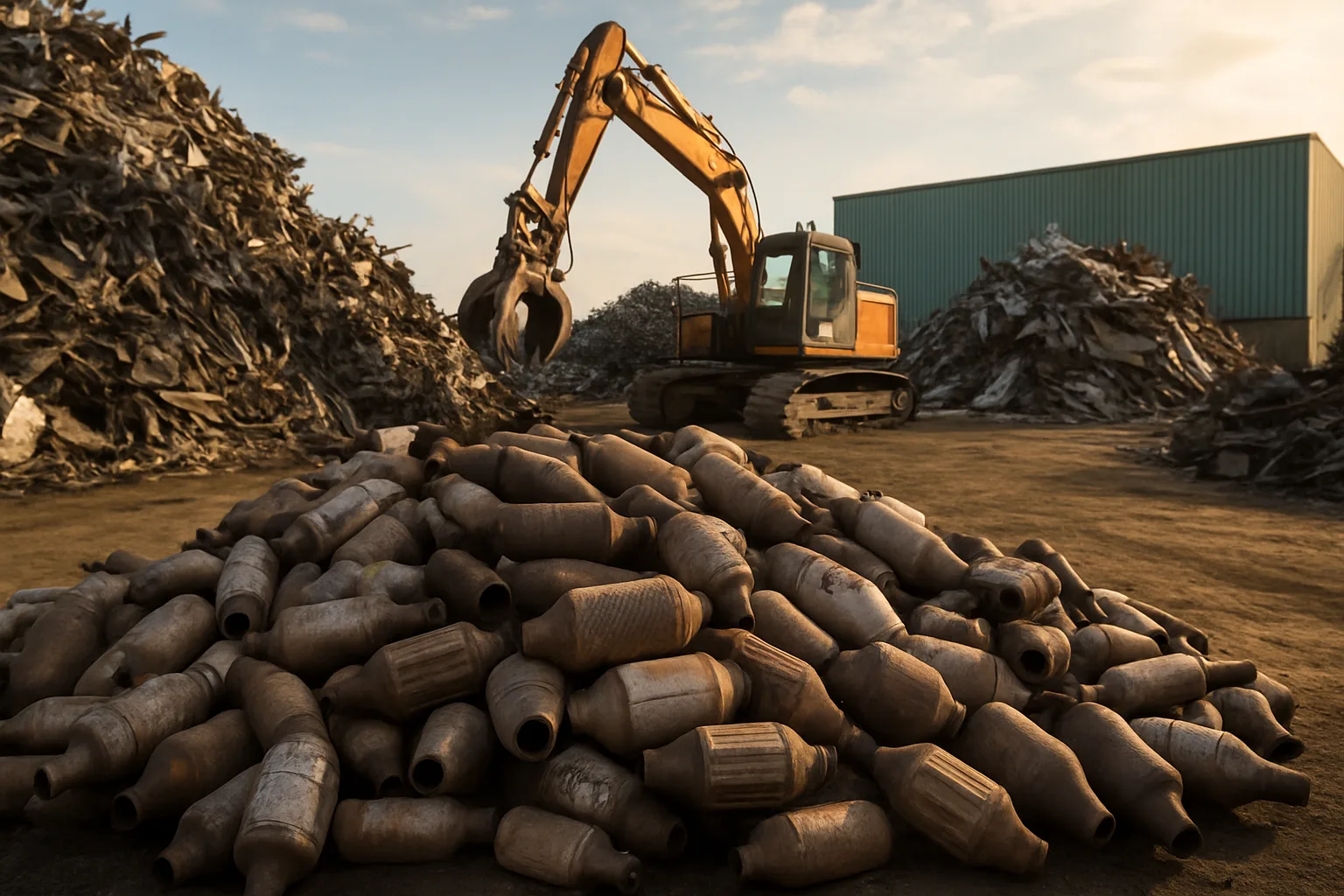
Most people have no idea what's inside a catalytic converter. But scrap buyers do — and that's exactly why prices swing so dramatically from one offer to the next. If you've ever been quoted wildly different numbers at different scrap yards, the answer isn't random. It's chemistry, market data, and how well the buyer actually knows what they're holding.
This guide breaks down how catalytic converter recycling actually works, what drives the price, and how to make sure you're not leaving money on the table when you go to sell your scrap metal in Canada on SellYourScrap.
---What's Actually Inside a Catalytic Converter
The converter itself is a steel canister. That part isn't worth much. What matters is the ceramic or metallic substrate inside — a honeycomb structure coated with platinum group metals (PGMs): platinum, palladium, and rhodium. These are among the most valuable metals on the planet, and a single converter can contain anywhere from one to ten grams of PGMs depending on the make, model, and year of vehicle.
The outer shell is typically stainless steel with some scrap value. But the PGM content is what drives the real price. When a recycler quotes you on a cat, they're estimating the recoverable PGM content — and that estimate depends on their data, their equipment, and their access to downstream processors who can actually refine those metals out.
Here's what determines PGM content in a converter:
- Vehicle make and model — A Toyota Prius converter contains significantly more palladium than a standard sedan. Trucks and SUVs often carry high-value units too.
- Engine type — Diesel converters have different PGM profiles than gasoline units. Some diesels carry more platinum; gas engines lean heavily on palladium.
- Year of manufacture — Older vehicles (pre-2000s) often have higher PGM loadings due to less-efficient converter designs that required more metal to meet emissions standards.
- OEM vs. aftermarket — Original equipment converters carry far more PGM content than cheap aftermarket replacements. An aftermarket "cat" might be worth a fraction of the original.
The Recycling Process: From Your Scrap Yard to the Refinery
What happens after you drop off a catalytic converter at a scrap yard near me open today? The process is longer and more technical than most people realize. The converter doesn't just get melted down on-site. It moves through a multi-step supply chain before those PGMs are recovered.
Here's the general flow:
- Collection and sorting — Scrap yards receive converters and sort them by type (foil, ceramic, diesel, etc.). This is where a good yard earns its money. Proper identification matters.
- Decanning — The metal shell is cut away to expose the substrate. Some yards do this in-house; others ship whole units.
- Processing — The ceramic substrate is crushed into a fine powder called "black powder" or "cat fines." This material is blended and sampled for PGM content.
- Assay sampling — A representative sample is tested to determine the exact PGM concentration. This is the critical step. The price paid depends heavily on the accuracy of this assay.
- Smelting and refining — The material is sent to a precious metals refinery where platinum, palladium, and rhodium are chemically separated and purified.
- Settlement — The refinery pays the processor based on recovered metal weights and current spot prices. That settlement works its way back through the chain.
Every hand the converter passes through takes a margin. That's why a converter worth $400 at refinery settlement might yield only $200-$280 at the street level. Understanding this chain helps you evaluate whether a quote is reasonable — or whether someone is taking too big a cut.
Why Catalytic Converter Prices Vary So Much — And What It Means for Sellers
This is the question that frustrates sellers most. You call three different yards in Etobicoke and get three different quotes. Which one is right? Here's what's actually happening.
Spot market volatility. Platinum, palladium, and rhodium trade on commodity markets. Rhodium in particular is notoriously volatile — it can swing hundreds of dollars in a single week during periods of supply disruption or demand shifts. A quote from Monday may not be valid by Friday. Always ask when a quote was last updated.
Buyer data quality. A yard with a good database of converter grades and a direct relationship with a downstream refinery will price more accurately — and often more competitively — than a yard guessing from a printed price sheet. Platforms like smashrecycling.ca connect sellers with vetted buyers who have this downstream knowledge, which translates to better price discovery for the seller.
Identification errors. Misidentifying a converter is common and costly. A buyer who can't tell a high-value Toyota hybrid unit from a standard sedan converter will underprice the former. VIN-based lookup tools and serial number tracking — tools increasingly used in scrap metal recycling Canada-wide operations — help close this gap. SMASH's platform uses serial tracking and photo documentation to reduce these identification errors at the point of sale.
Aftermarket vs. OEM confusion. Visually, OEM and aftermarket converters can look similar. But the price difference is enormous. An aftermarket unit might fetch $15-30. The OEM equivalent could be worth ten times that. Sellers should know what they have before they walk in.
Local market competition. In dense urban areas like Etobicoke, Ontario, there are more buyers competing for material, which generally improves pricing. In rural areas with fewer options, sellers have less leverage. This is exactly why auction-based platforms exist — to bring competition to sellers who would otherwise rely on a single phone call.
What You Can Do to Get a Better Price for Your Cats
You don't need to become a metallurgist. But a few steps can meaningfully improve what you're paid — whether you're selling one converter from a beater or a load of 50 from a fleet teardown.
Know what you have. Before you call any yard, identify the converter by serial number or by the vehicle it came from. There are databases — some free, some paid — that cross-reference serial numbers to known PGM content ranges. Even a rough idea of what you're holding gives you negotiating context.
Get multiple quotes. Don't accept the first number. Call at least three buyers. In a market like Etobicoke, you have options. Use them. Competition is the only honest price discovery mechanism in this business.
Document your inventory. If you're selling a load of cats, photograph each unit before you hand it over. Note serial numbers where visible. This protects you if there's a dispute over identification after the fact and gives buyers more confidence in what they're bidding on.
Use platforms with vetted buyers. One-off cold calls to unknown yards carry risk. Platforms that vet buyers and create competitive bidding environments reduce that risk. SMASH is built specifically for this — connecting sellers of catalytic converters and other scrap with qualified buyers across North America. No subscription fees. They only win when the seller wins.
When you're ready to get a fair price for your scrap today, going in with documentation and multiple competitive bids is the single biggest thing you can do to protect your return.
Regulation and Compliance: What's Changed in 2026
Catalytic converter theft has driven significant regulatory attention across Canada over the past several years, and 2026 has brought more structured enforcement at the provincial level. In Ontario, scrap yards are now subject to stricter transaction documentation requirements — including seller identification, vehicle documentation, and in some cases, mandatory hold periods before payment on certain converter types.
This isn't a bureaucratic headache. It's actually good for legitimate sellers. It reduces the volume of stolen material flowing into the market, which depresses prices for everyone. Cleaner supply chains mean more confident buyers, and more confident buyers pay better.
If you're selling converters from your own vehicles or your business's fleet, keep your paperwork clean. Bill of lading, proof of ownership, business registration if you're selling commercially — have it ready. Yards that ask for this aren't being difficult. They're protecting themselves and, by extension, you.
For businesses doing volume, auto-invoicing tools and compliant transaction records aren't optional anymore — they're table stakes. Platforms built for scrap metal recycling Canada-wide compliance make this significantly easier than managing it manually.
Aluminum, Copper, and the Rest: Don't Leave Other Metal Behind
When you pull a catalytic converter, you're often working on a vehicle or in a yard where other valuable scrap is sitting too. Don't walk away from it.
Copper wiring, aluminum radiators, and steel components all have real market value. The aluminum scrap price today varies by grade — cast aluminum trades differently than extrusion-grade or sheet — but it's worth separating and getting a proper quote rather than lumping it in as mixed metal.
Copper is consistently one of the most valuable non-ferrous metals in the scrap yard downtown market. Bare bright copper trades at a meaningful premium over insulated wire. If you're doing a full vehicle teardown or a shop cleanout, sorting your material before you show up pays off every time.
You can explore Canadian scrap metal guides for more detail on how different metals are graded and priced — understanding the basics before you sell is one of the easiest ways to protect your margin.
When you're ready to move material — converters, non-ferrous, ferrous, whatever you've got — the right move is to get it in front of multiple buyers. That's what smashrecycling.ca is built to do. More competition. Better price discovery. No guessing.
Whether you're clearing out a single garage vehicle or managing regular commercial volumes in Etobicoke or anywhere else in Ontario, you deserve to know what your scrap is actually worth. Start at sellyourscrap.ca — request a pickup, get a real quote, and stop leaving money on the table.
Disclaimer: Scrap metal prices — including platinum, palladium, and rhodium — fluctuate daily based on global commodity markets. All price references in this article are illustrative. Check current rates before selling.
---Frequently Asked Questions
Q: How much is a catalytic converter worth at a scrap yard in Etobicoke?
It depends entirely on the make, model, and whether it's OEM or aftermarket. OEM converters from hybrid vehicles can command significantly higher prices than standard units. Get multiple quotes from buyers in Etobicoke before committing to a sale — prices vary more than most sellers expect.
Q: Why do scrap yards pay different prices for the same catalytic converter?
Different yards have different access to downstream refineries, different data for identifying converter grades, and different margins they're willing to work at. Market timing also matters — PGM spot prices move daily. A competitive auction environment removes most of this guesswork.
Q: Is it legal to sell catalytic converters for scrap in Ontario?
Yes, provided you can document ownership or lawful possession. Ontario has strengthened documentation requirements for converter transactions in recent years. Bring proof of ownership — for vehicles, your registration or title — and valid ID. Legitimate yards will ask for this regardless.
Q: What's the difference between an OEM and aftermarket catalytic converter for scrap value?
Dramatically different. OEM converters contain meaningful amounts of platinum, palladium, and rhodium. Cheap aftermarket replacements contain very little PGM content and may fetch only a fraction of the price. If you know your converter is OEM, say so — and be prepared to prove it with the vehicle VIN.
Q: How do I find a reputable scrap yard near me in the Etobicoke area?
Look for yards that ask for proper documentation, provide itemized quotes, and can explain how they price converters. Better yet, use a platform that connects you with multiple vetted buyers so you're not dependent on whoever happens to be nearest. More competition means a fairer price.
---Follow SMASH on LinkedIn for ongoing scrap metal market updates, pricing insights, and industry news across Canada and North America.